
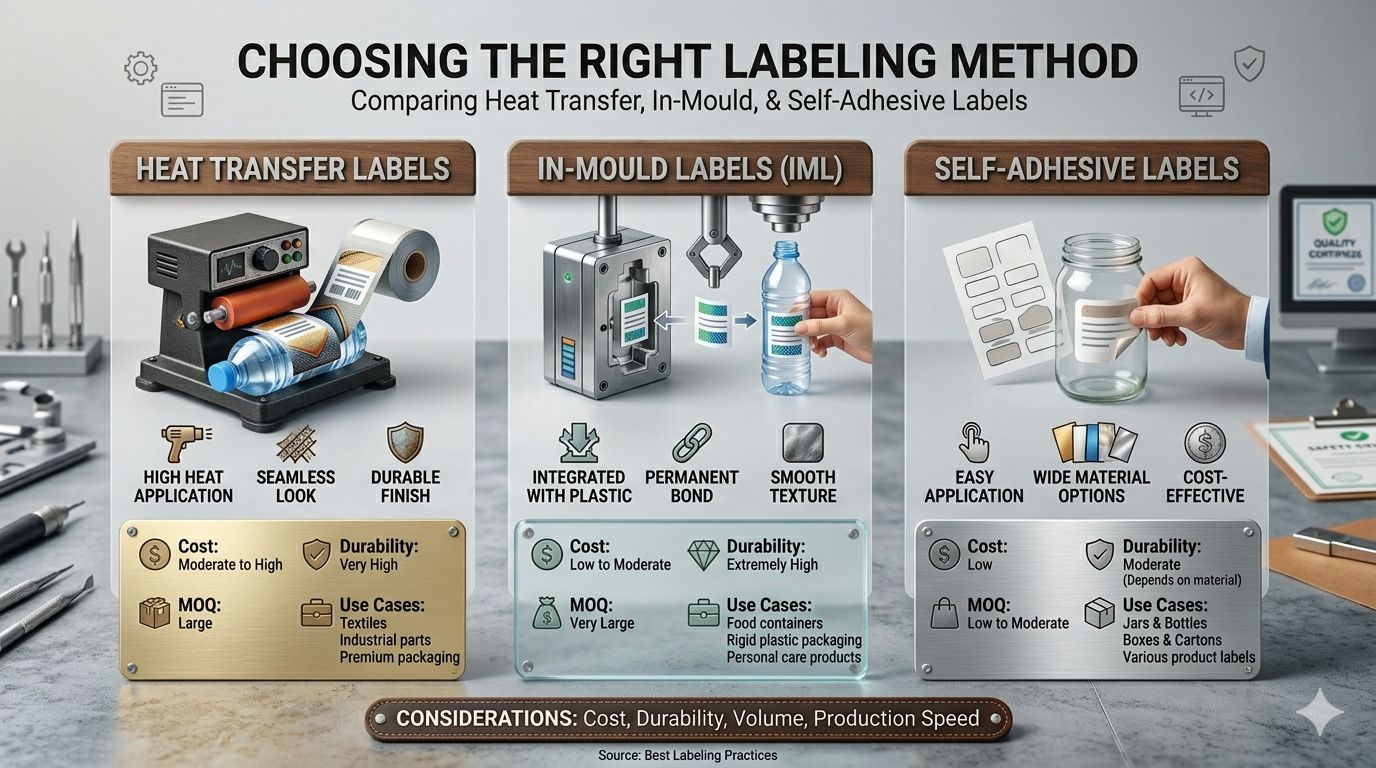
A complete decision guide for brand owners, packaging managers, and procurement teams choosing between Heat Transfer Labels, In-Mould Labels, and Self-Adhesive Labels in 2026.
Quick Summary (For The Time-Pressed)
If you’re short on time, here’s the one-sentence answer for each:
- Self-Adhesive Labels are the most flexible, cost-effective option for most products — choose them unless you have a specific reason not to.
- Heat Transfer Labels (HTL) give you a no-label-look premium finish that integrates seamlessly into the container — choose them when label aesthetics directly impact perceived product value.
- In-Mould Labels (IML) become physically part of the container — choose them for high-volume runs of plastic containers where durability and tamper-resistance are non-negotiable.
If that’s enough for you, request a free sample of all three and our team will help you pick. If you want to understand why — keep reading.
Why This Decision Matters More Than You Think
Picking the wrong label technology costs you in ways that aren’t obvious until it’s too late.
A pharma brand we worked with had been using self-adhesive labels for a fast-moving cough syrup line. The labels kept peeling at the edges in humid coastal warehouses. Customer complaints rose. Returns climbed. They eventually switched to HTL — but only after losing six months of margin to the fix.
A cosmetics startup chose IML for their hero product because their manufacturer recommended it. The label looked stunning on shelf. But when they wanted to refresh artwork after six months of market feedback, they learned IML changes require new mould inserts and minimum runs of 50,000 units. They were locked in.
The right label for your product depends on six factors:
- What container material are you labelling? (plastic, glass, metal, paper)
- What environment will the product face? (humidity, temperature, abrasion, chemicals)
- What volume are you producing? (sample run vs. mass production)
- How often will artwork change? (seasonal refresh vs. years-stable)
- What’s your aesthetic goal? (premium no-label-look vs. functional)
- What’s your unit economics tolerance? (cost per label matters more or less)
This guide walks through all three label types against these factors, then gives you a clear decision framework.
Self-Adhesive Labels: The Versatile Workhorse
What They Are
Self-adhesive labels — also called pressure-sensitive labels or PSL — are pre-printed labels with an adhesive backing protected by a release liner (the “peel-off” paper). They’re applied by removing the liner and pressing the label onto the container.
You see them everywhere: shampoo bottles, medicine vials, food jars, lubricant cans, cosmetic tubes, paint buckets. They’re the most widely-used label format globally for good reason — they work on almost everything.
How They’re Made
The label material (paper or film) is laminated with adhesive, printed using flexography, offset, or digital printing, die-cut to shape, and supplied on rolls or sheets. Modern self-adhesive label production allows for incredibly fine detail, special effects (foil, embossing, varnish), and rapid turnaround on small runs.
When Self-Adhesive Labels Are The Right Choice
You should choose self-adhesive labels when:
- You’re labelling multiple container types (glass, plastic, metal, cardboard) and want one consistent label format across SKUs
- Your production volumes vary between products or seasons — self-adhesive runs as small as 500 units are economical
- You change artwork frequently for promotional campaigns, seasonal variants, or compliance updates
- You need multiple language versions for different export markets
- Your product line has many SKUs with low individual volumes — common in pharma, specialty chemicals, and niche FMCG
- You want fast turnaround — most self-adhesive jobs ship within 7-15 days
- You require special features like tamper-evident seals, scratch-and-reveal codes, multi-layer booklets, or QR-code authentication
Strengths
- Lowest barrier to entry — small minimum order quantities (typically 500-5,000 units depending on complexity)
- Fastest production turnaround in the industry
- Versatile substrate options — paper, polypropylene (PP), polyethylene (PE), polyester (PET), specialty films
- Wide range of finishes — matte, gloss, soft-touch, metallic, holographic, embossed
- Easy to combine with security features — VOID labels, holograms, multi-layer constructions, NFC chips, QR codes
- Industry-standard — every co-packer, every filling line, every contract manufacturer is set up to apply self-adhesive labels
Weaknesses
- Edges can lift over time in humid environments or temperature cycling
- Visible label seam — never achieves the seamless “no-label” appearance that HTL or IML deliver
- Adhesive failure on certain substrates — silicones, oily plastics, some recycled materials require specialty adhesives
- Less durable than HTL or IML against abrasion, chemicals, and prolonged outdoor exposure (though premium materials close this gap significantly)
Typical Industries Using Self-Adhesive
Pharmaceutical, food and beverage, FMCG/cosmetics, agrochemicals, lubricants, paints and coatings, industrial chemicals, automotive aftermarket, electronics, nutraceuticals.
At S. Anand Packaging, self-adhesive labels are our oldest and largest production capability. We produce over a million labels a day across paper, film, and specialty substrates from our Noida facility. Request a free sample of any specification you’re considering.
Heat Transfer Labels (HTL): The Premium Finish
What They Are
Heat Transfer Labels are pre-printed graphics on a carrier film, transferred onto a container using heat and pressure. The label fuses into the surface of the container, leaving no visible edge or seam — a true “no-label-look” finish.
If you’ve ever picked up a premium-quality plastic bottle and thought “how did they print directly onto this?” — you were probably looking at an HTL application.
How They’re Made
Artwork is printed in reverse onto a special transfer film. The film is positioned against the container, and a heated transfer mechanism applies pressure for a few seconds. The ink layer transfers and bonds permanently to the container surface, and the carrier film peels away. The result: graphics that appear part of the container itself.
When HTL Is The Right Choice
You should choose Heat Transfer Labels when:
- Your product positions itself as premium or luxury — and label aesthetics drive perceived value (premium cosmetics, fine spirits, automotive lubricants, high-end personal care)
- Your container is plastic with a smooth or textured surface — HTL works best on polyethylene, polypropylene, and similar materials
- You need labels that survive abrasion, friction, and contact with skin/hands — HTL ink is fused into the container and doesn’t peel
- You want 360-degree wraparound graphics without a visible seam
- You’re producing mid-to-high volumes (typically 25,000+ units per design) where HTL economics work
- You need excellent chemical resistance — HTL holds up to oils, lotions, alcohols, and most industrial chemicals
- Your product faces moisture, humidity, or temperature variation — HTL doesn’t peel, lift, or curl
Strengths
- Seamless, integrated appearance — labels look painted-on, not stuck-on
- Highly durable — won’t peel, lift, fade, or scratch off in normal use
- Resistant to moisture, oils, chemicals that would defeat self-adhesive labels
- No edges or seams — prevents bacterial harborage (important in pharma and personal care)
- 360-degree branding with continuous artwork
- Reduces SKU complexity — same container, same label process, multiple printed designs
- Excellent for textured or shaped containers where flat self-adhesive labels don’t conform well
Weaknesses
- Higher minimum order quantities — typically 25,000+ units make HTL economical
- Less flexibility for artwork changes — every variant requires a new transfer film setup
- Container compatibility matters — some plastics and surface treatments don’t accept HTL well; testing is essential
- Specialised application equipment required — your filling line needs HTL applicators (a one-time investment)
- Slower line speeds than self-adhesive in high-volume packaging operations
Typical Industries Using HTL
Premium personal care, cosmetics, automotive lubricants, paints, household cleaning products, premium food and beverage, agrochemicals, healthcare consumer products, industrial fluids.
At S. Anand Packaging, our HTL production capability serves brands across automotive lubricants, premium FMCG, paints, and cosmetics. We work with you to ensure container-substrate compatibility before committing to production. Request a free HTL sample on your container material.
In-Mould Labels (IML): The Permanent Integration
What They Are
In-Mould Labels are pre-printed labels placed inside the mould of a plastic container during the manufacturing process. As the molten plastic forms the container, it bonds with the label permanently. The label becomes the container surface — there’s no separate “label” and “container,” just one integrated piece.
You’ve seen IML on premium ice cream tubs, large detergent buckets, paint pails, margarine containers, and many household chemical bottles. The label feels like part of the plastic because it is.
How They’re Made
IML labels are pre-printed on polypropylene film with specialised inks. They’re cut to shape, fed into the injection moulding or blow moulding cavity by robotic arms, and held in place electrostatically. Molten plastic is injected, fusing with the label. The container ejects from the mould fully labelled — no secondary labelling step needed.
When IML Is The Right Choice
You should choose In-Mould Labels when:
- You’re producing plastic containers that you also manufacture (or your moulder can run IML)
- Your annual volumes are high — IML economics need typically 100,000+ units per design to compete with self-adhesive
- Your product faces harsh conditions — direct sunlight, freezer-to-counter cycles, dishwashers, prolonged outdoor exposure, industrial environments
- You need maximum tamper-resistance — IML labels are physically impossible to remove without destroying the container
- You want to eliminate a labelling step from your production line — IML containers arrive pre-decorated
- Your design is stable and unlikely to change for 1-3 years
- You compete on shelf appearance — IML delivers a high-gloss, premium finish that’s notably superior to self-adhesive
- You want perfect recyclability — many IML systems use the same plastic for label and container, supporting mono-material recycling streams
Strengths
- Indestructible label-container bond — label is literally part of the plastic
- Highest visual quality — sharp graphics, deep colours, glossy or matte finish, metallic effects
- Eliminates labelling line — no separate label application step needed
- Survives extreme conditions — freezer storage, hot water, abrasion, UV exposure, chemicals
- Tamper-evident by nature — any attempt to remove the label damages the container
- Mono-material recyclability — when label and container are the same plastic (typically PP), the unit recycles cleanly
- Premium shelf appeal — high-gloss surface finish is unmatched by other label types
Weaknesses
- Highest minimum order quantities — economically viable typically at 100,000+ units per design
- Inflexible to design changes — new artwork means new printing plates and potentially new mould tooling
- Only works on plastic containers — not glass, metal, or paperboard
- Requires moulding integration — your container moulder must have IML capability or you must source IML-ready containers
- Higher upfront tooling and setup — but lower per-unit cost at high volumes
- Longer lead times — IML production cycles are slower than self-adhesive jobs
Typical Industries Using IML
Dairy and ice cream containers, paint and coatings buckets, large-format detergent containers, premium yoghurt tubs, butter and margarine packaging, industrial chemical pails, automotive lubricant containers, premium pet food containers.
At S. Anand Packaging, our IML capability serves brands needing the durability and shelf-appeal that only in-mould labelling delivers. We work closely with your container moulding partner to ensure label-mould compatibility. Request an IML consultation to evaluate fit for your product.
Side-by-Side Comparison
| Factor | Self-Adhesive | Heat Transfer (HTL) | In-Mould (IML) |
|---|---|---|---|
| Minimum order quantity | 500–5,000 units | 25,000+ units | 100,000+ units |
| Cost per label (low volume) | Low | High | Very high |
| Cost per label (high volume) | Medium | Low | Lowest |
| Production lead time | 7–15 days | 15–25 days | 30–45 days |
| Artwork change flexibility | Excellent | Moderate | Difficult |
| Container compatibility | All materials | Mainly plastic | Plastic only |
| Visual finish quality | Good to excellent | Premium | Premium+ |
| No-label-look finish | No | Yes | Yes |
| Durability (peel/lift) | Moderate | Excellent | Indestructible |
| Resistance to humidity | Moderate | Excellent | Excellent |
| Resistance to chemicals | Varies by substrate | Excellent | Excellent |
| Resistance to abrasion | Moderate | Excellent | Excellent |
| Tamper resistance | Add-on feature | Inherent | Maximum |
| Recyclability | Depends on materials | Good | Excellent (mono-material) |
| Suitable for small SKU runs | Yes | No | No |
| Suitable for premium positioning | Yes (with effort) | Yes | Yes |
| Eliminates labelling step in production | No | No | Yes |
The Decision Framework
Here’s how we recommend you actually decide. Run your product through these questions in order:
Question 1: What’s Your Annual Volume Per Design?
- Under 25,000 units → Self-Adhesive is your only economical option. Move to Question 5.
- 25,000–100,000 units → Choose between Self-Adhesive and HTL. Move to Question 2.
- 100,000+ units → All three are options. Move to Question 2.
Question 2: What’s Your Container Material?
- Plastic only → All three remain viable. Move to Question 3.
- Glass, metal, paperboard, or mixed materials → Self-Adhesive is required (HTL works only on specific plastics, IML doesn’t apply at all). Move to Question 5.
Question 3: How Often Does Your Artwork Change?
- Frequently (every 6 months or sooner) → Self-Adhesive. The cost of design changes wipes out IML/HTL savings.
- Annually → HTL works, but plan changes carefully. IML usually doesn’t.
- Stable for 2+ years → IML and HTL are excellent fits.
Question 4: What’s Your Aesthetic and Durability Priority?
- Premium feel, no visible label edges, must survive use (luxury cosmetics, lubricants, premium personal care) → HTL is the gold standard.
- Maximum shelf-appeal, indestructible bond, large rigid containers (paint pails, large detergent containers, premium ice cream tubs) → IML wins.
- Functional, flexible, multi-purpose → Self-Adhesive.
Question 5: Special Requirements?
- Need anti-counterfeiting features (QR, scratch codes, AI verification) → Self-Adhesive with SAP SecureLabel integration.
- Need multilingual or extended content → Multi-layer self-adhesive (booklet labels).
- Need tamper-evidence beyond what’s standard → IML for permanent, or specialised self-adhesive (VOID labels, security cuts).
- Need recyclability for sustainability claims → IML (mono-material) or specific paper-based self-adhesive constructions.
Common Mistakes to Avoid
After working with hundreds of brands, here are the patterns we see go wrong:
Mistake 1: Choosing Based on Cost-Per-Label Alone
A label that costs ₹0.40 but causes 2% returns due to peeling is far more expensive than a label that costs ₹0.80 and never fails. Total cost of ownership matters more than unit cost.
Mistake 2: Ignoring Container-Substrate Compatibility
Not all plastics accept all label technologies equally. Recycled HDPE often rejects HTL inks. Silicones reject most adhesives. Always test on your actual container before committing to production runs.
Mistake 3: Locking Into IML Too Early
IML is brilliant for stable, high-volume products. It’s a trap for anything that might need design iteration. New brands underestimate how many artwork changes happen in the first two years post-launch.
Mistake 4: Underestimating Application Equipment
HTL requires specialised applicators on your filling line. IML requires moulding integration. Self-adhesive works on virtually any line. Your existing equipment determines real options more than you might think.
Mistake 5: Treating Labels as a Commodity
The right label is part of your product positioning. A premium spirit in a self-adhesive label looks like a budget spirit in a premium bottle — wrong format dilutes the brand.
When to Use a Combination
Most established brands use multiple label technologies across their portfolio:
- A premium cosmetics brand might use HTL on flagship products, self-adhesive on rapidly-iterating new launches, and IML on large-format refill packs.
- A pharma company typically uses multi-layer self-adhesive on bottles needing extended content, simple self-adhesive on vials, and might have IML on bulk dispensers.
- An automotive lubricant brand often uses HTL on premium retail packs, self-adhesive on bulk packs, and IML on industrial drums.
There’s no rule that says you must standardise on one technology. Choose what’s right per product.
Why This Decision Is Easier With the Right Partner
Most brands don’t have label engineering expertise in-house — and they shouldn’t. This is why label specialists like us exist. The questions you should expect a good labelling partner to ask before recommending anything:
- What container material and supplier?
- What are the conditions the product will face from production to consumer?
- What’s your annual volume and growth projection?
- What does your filling line look like?
- What’s your brand positioning and aesthetic goal?
- What’s your design change cadence?
- Are there compliance requirements (pharma, food, child-safety)?
- What sustainability commitments do you have?
If a vendor jumps to a recommendation without asking these questions, find a different vendor.
Why Choose S. Anand Packaging
We’ve been manufacturing labels for over 35 years from our Noida facility. Across that time, we’ve built capabilities in all three label technologies covered in this guide — self-adhesive, heat transfer, and in-mould labelling — and we know when to recommend each.
What sets us apart:
- 35+ years of label manufacturing experience across pharma, FMCG, automotive, agrochemicals, and cosmetics
- 300+ brands served across India and export markets
- 1 million+ labels produced daily from our Noida facility
- ISO 9001, GMI, and Sedex certified — full quality and ethical compliance
- All three label technologies under one roof — we recommend what’s right for you, not what we have inventory in
- Pan-India delivery with strong logistics across north and west India
- In-house design and prototyping — quick iteration on samples
- SAP SecureLabel — our anti-counterfeiting label system, deployable across all three label types
We’re happy to consult on your specific situation, run sample productions on your container materials, and help you avoid costly mistakes others have made before you.
Get Started
The fastest way to make this decision is to put real samples in your hands.
Two Ways to Move Forward
1. Request a Free Sample Pack
We’ll send physical samples of self-adhesive, HTL, and IML labels — including label-on-container examples — so you can see and feel the differences. No commitment.
Request Your Free Sample Pack →
2. Get a Custom Quote
Tell us about your product, container, volume, and use case. Our team will recommend the right label technology and provide pricing.
Or reach us directly:
- 📞 +91 97185 85190
- 📧 parshav@sapackaging.co.in
- 📍 B-51, Sector 88, Noida, Phase-II, UP – 201305
Frequently Asked Questions
Can I switch from self-adhesive to HTL or IML later?
Yes, but it’s significant. Switching to HTL requires application equipment and re-tooling. Switching to IML requires coordination with your container moulder and new tooling. The earlier you make the right choice, the lower your switching cost.
Which label type is most environmentally friendly?
It depends. IML using the same plastic as the container (mono-material) is highly recyclable. Paper-based self-adhesive with washable adhesives is recyclable in many waste streams. HTL has minimal recycling impact since the ink is part of the container surface. Talk to your sustainability team and consult your local recycling streams — there’s no universal answer.
Do all three label types support QR codes for anti-counterfeiting?
Yes. We integrate QR codes, scratch codes, and AI-verified authentication features (via our SAP SecureLabel system) across all three label technologies.
What’s your typical lead time for samples?
Self-adhesive samples: 5-7 days. HTL samples: 10-15 days (we may need to source compatible container samples). IML samples: 15-25 days (requires coordination with moulding partner).
Do you handle export orders?
Yes. We export to multiple markets and handle the documentation and packaging requirements for international shipping.
What’s the smallest order you’ll accept?
For self-adhesive labels, we’ll work with orders as small as 500 units for prototyping or specialty applications. HTL practical minimum is around 25,000 units per design. IML practical minimum is around 100,000 units per design.
How do I get started if I’m a new brand?
Request a free sample pack first. Then have a conversation with our team about your product specifics — we’ll guide you to the right technology before you commit to anything.
Have a specific product question? Drop us a line — we’re happy to consult, even if you ultimately go with a different supplier. Most of our long-term clients started with a question they thought was simple but turned out to be more nuanced. We’d rather give you good advice now than poor advice that comes back to haunt both of us.
