
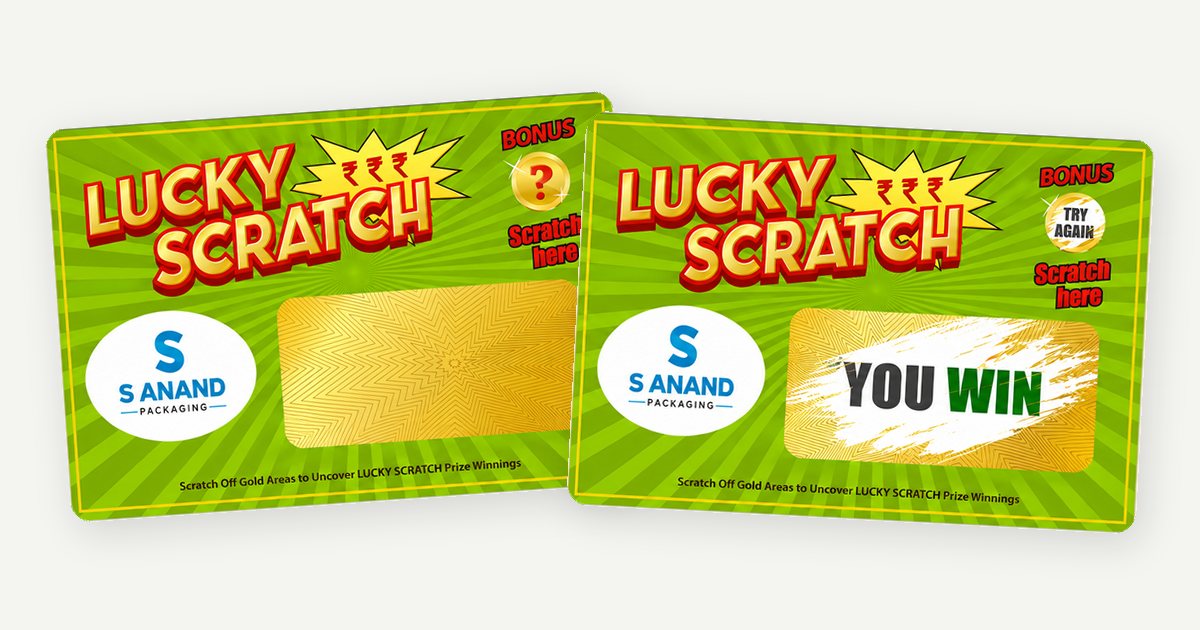
Illustrative mockup: a scratch panel before and after reveal. The gold panel is screen printed over a release coat, so it lifts cleanly without damaging the code beneath.
Every festive season, the same problem lands on the marketing team’s desk. Diwali, Navratri and the run-up to New Year are the months when shelves get crowded, when three brands in the same category all discount at once, and when the shopper standing in front of the rack has roughly four seconds to choose. Price cuts work, but they work for everyone, and they train the customer to wait for the next cut.
A scratch label does something different. It converts the pack itself into the reward mechanism. The shopper does not have to register, wait for a draw, or trust that a code will be honoured next month. They scratch a silver panel with a coin and find out immediately.
That immediacy is the entire commercial argument for the format, and it is why scratch cards and scratch-off labels keep coming back into festive campaigns across FMCG, food and beverage, cosmetics and automobile aftersales.
What a scratch label actually is
Underneath the marketing, a scratch-off panel is a printing problem with three layers.
The concealed layer. This is the prize, code or message. It can be static (the same message on every pack) or variable — a unique alphanumeric code, serial number or QR generated per unit and printed digitally.
The release coat. A clear varnish laid over the concealed print. This is the layer that decides whether the scratch panel comes away cleanly or smears the code underneath. It is invisible in the finished label and it is the most common failure point in cheaply produced scratch work.
The scratch-off panel. Usually an opaque silver or grey ink, applied by screen printing in several passes to build enough opacity that the code cannot be read by holding the label to a light. Colour panels, brand-tinted panels and panels overprinted with a logo or festive motif are all possible.
Get the release coat and the panel opacity right and the label behaves the way a customer expects. Get them wrong and you get two failure modes that both damage the campaign: panels that flake off in transit and expose winners before purchase, or panels that refuse to scratch and take the printed code away with them.
Scratch label, scratch card, or both
These are not the same product and they solve different problems.
On-pack scratch labels are self-adhesive labels applied directly to the primary or secondary pack. The promotion travels with the product, so there is nothing for the retailer to hand out and nothing to lose. Best suited to FMCG, personal care, beverages and any SKU where the pack is already labelled.
Standalone scratch cards are printed on board or card stock and inserted into cartons, handed out at counters, distributed by field teams or included in dealer kits. They work when you do not want to modify the pack artwork mid-season, or when the promotion is aimed at the trade rather than the consumer.
Scratch plus QR hybrids conceal a unique code that the customer scans or enters on a microsite. This is the version worth arguing for if the marketing team cares about data. The scratch is the hook; the code is the mechanism that tells you which SKU, which batch and which region redeemed.
Peel-and-reveal labels are the alternative when you need more space than a scratch panel allows — a multi-layer label that opens to reveal terms, a longer message or a second code underneath. Useful where regulatory text has to accompany the offer.
Where the format earns its cost
Instant gratification beats deferred reward
A festive campaign that asks the customer to photograph a receipt, upload it and wait for a draw loses people at every step. A scratch panel collapses that funnel into one action performed at the shelf or in the car park. Even when most panels are “better luck next time,” the act of scratching is the engagement — the customer has physically interacted with your pack.
It moves stock during the window that matters
Festive demand is compressed. Scratch promotions are typically structured so that a proportion of panels carry small, high-frequency rewards — a discount on the next purchase, a free sachet, a coupon — rather than a single large prize nobody expects to win. High-frequency small wins drive repeat purchase inside the same season, which is usually the actual objective.
It gives you first-party data
If each panel conceals a unique code, redemption tells you things retail sell-out data cannot: which regions are actually converting, which pack size is being bought as a gift versus for self-use, and which distributor’s stock is moving. Pair the code with a landing page and you have a consented contact list built during the highest-traffic weeks of the year.
It works for channel and trade loyalty too
Consumer promotions get the attention, but scratch cards are equally used in dealer and distributor schemes — a card in each carton of stock, a scratch panel on a service reminder, an incentive card for retail staff who push a particular SKU. In the automobile aftersales space this is a well-established mechanic for service campaigns.
It is a security format wearing a marketing costume
The same construction used for promotions is used for authentication. A scratch panel over a unique verification code lets a customer confirm the product is genuine before use. If your category has a counterfeit problem, a festive promotion is a reasonable excuse to introduce the habit of scratching and verifying.
What to specify before you print
A scratch campaign fails in production more often than it fails in concept. The specification conversation should cover:
Variable data method. Sequential codes are easy to guess and easy to defraud. Randomised, non-sequential codes drawn from a much larger space than the number of units printed are the minimum. The code list should be generated, encrypted and reconciled properly — not exported from a spreadsheet.
Panel opacity. Ask for a physical sample held against a strong light. If the code reads through, the panel needs another pass.
Substrate and adhesive. A scratch label on a chilled beverage, a cosmetic tube and a corrugated carton are three different adhesive problems. Condensation, curved surfaces and low-surface-energy plastics all change the answer.
Tamper evidence. If someone can lift the label, read the code and reapply it, the promotion has a hole in it. Destructible facestock or a tamper-evident die cut closes it.
Secondary security. Microtext, guilloche patterns, UV-visible elements or a specialist varnish under the panel make a scratch label difficult to reproduce. Worth adding when prizes are large.
Compliance. Promotional contest rules in India vary by state, and prize-linked promotions attract specific requirements around disclosure of terms, the number of prizes, the closing date and, in some states, restrictions on chance-based schemes. Legal review before artwork is finalised is cheaper than a recall of printed stock. Your legal team, not your printer, should sign this off.
Lead time. Screen-printed scratch panels, variable data printing and code reconciliation add steps to the schedule. Festive artwork that arrives in the last week of the month is a festive campaign that launches after the season.
A realistic festive timeline
Working backwards from a Diwali launch, a well-run scratch campaign looks roughly like this: prize structure and legal clearance settled first, artwork and code architecture next, a physical sample approved on the actual substrate, then production, then distribution with enough buffer for stock to reach the last mile before the promotion goes live. Compressing the sample approval stage is the most common and most expensive shortcut.
Where S. Anand Packaging fits
We manufacture scratch cards and scratch-off labels alongside self-adhesive labels, shrink sleeves, multi-layer peel-reveal labels, security labels and QR code labels, from our facility in Noida. Our print technologies include flexographic, screen, gravure and digital, which matters here because a scratch label is rarely a single-process job — the panel is screen printed, the base label may be flexo, and the variable codes are digital.
We work with pharmaceutical, FMCG, cosmetic, food and beverage and automobile customers, and we hold ISO, GMI and Sedex certifications. If you are planning a festive on-pack promotion and want to see physical samples of scratch panels on your own substrate before committing artwork, that is a conversation worth having early rather than in October.
Frequently asked questions
What is the difference between a scratch label and a scratch card?
A scratch label is a self-adhesive label applied to the product pack, so the promotion travels with the product. A scratch card is a standalone printed card inserted into cartons or handed out separately. Labels suit consumer on-pack promotions; cards suit trade schemes and counter distribution.
Can each scratch label carry a unique code?
Yes. Unique alphanumeric codes, serial numbers or QR codes can be printed digitally under the scratch panel, with each unit carrying a different value. This is what allows redemption tracking and per-unit authentication.
Are scratch-off labels only for promotions?
No. The same construction is widely used for product authentication, where the panel conceals a verification code the customer checks against a brand database, and for software or recharge activation codes.
What surfaces can scratch labels be applied to?
Most standard packaging surfaces — cartons, bottles, tubes, pouches, corrugated boxes. The adhesive and facestock need to be selected for the specific substrate and storage conditions, particularly for chilled or oily surfaces.
How far in advance should a festive scratch campaign be planned?
Early enough to include prize structure, legal clearance, code generation, physical sample approval on the actual substrate, production and distribution to the last mile before the promotion goes live. Sample approval is the stage most often compressed and the one most likely to cause problems.
Are promotional scratch card schemes regulated in India?
Prize-linked promotions are subject to state-level rules and disclosure requirements, and some states restrict chance-based schemes. Have the campaign structure and terms reviewed by your legal advisors before artwork is finalised.
